Literature: Time and Place in SimCity
While SimCity seems at first glance to be fairly ahistorical in the operation of it's underyling simulation, the way it is presented to the player certainly paints a picture of a specific place and time. One often underappreciated feature of the game may give a first indication. Building sets always were a feature, going back to the very first title released 1989. Though only from SimCity 3000 foward was it utilized reflect contemporary and historically relevant architectural styles which carried over and grew more coherent with SimCity 4. The game features three architectural styles exemplified, literally, by a specific time and place, those being Chicago 1890, New York 1940 and Houston 1990. A fourth one, Euro-Contemporary, was released as part of the "Rush-Hour" Expansion, which came out later in the same year as SimCity 4.
Building sets represent pools of potential buildings from which the game draws as it develops a zone. It should be noted that building sets only affect residential and commercial, but not industrial zones and in addition some basic buildings are shared between all building sets, as can be seen in the first two screenshots below. The first two building styles seem to be rather focused on Victorian and Modernist/Art Deco architectural styles, while the latter focus on Postmodernist and a generalized, stereotypical vision of European architecture.

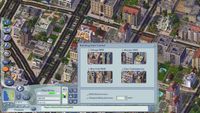
Though it should be noted that, as Morgan R on the Simtropolis forum worked out, the building sets are more specific to architecture prominent during the specified timeperiod, rather than architecture dominant specifically in the cities of Chicago, New York and Houston at the time, save for some prominent examples. Still we do have an explicit focus on the American city in the most general sense and given the focus SimCity's simulation places on market oriented policies, perhaps this shouldn't be surprising. There is another indicator by which we can ascertain that SimCity is especially focus on typically American styles of urban citybuilding, that being it's adherence to a gridsystem. While later titles, such as SimCity Creator for the Nintendo Wii and later SimCity (2013) did incorporate free-form roads allowing curves and large roundabouts, SimCity 4 adheres to the rectulangar grid system used by it's predecessors.
It is noteworthy in this context that any land that is zoned over a larger area causes the game automatically generate a grid pattern for it, as seen in the screenshot below.

As Lauwaert argues, there is a fundamental difference between the structures of European and American Cities, which is reflected in their most fundemantal layout, caused in part by the availablility of plenty of land during the colonial expansion into North America, prompting city planners there to lay out a repeating grid pattern that would simply grow with the population. She argues that the grid structure, in turn, is indicative of an city optimized for commerce, rather than one build around collective values and identities. (Lauwaert 197)
SimCity does, in no small part, conform to both ideas, thanks to it's economic model, which does bind commercial desirability to proximity to high-capacity roads for example, but the game is generally optimized towards a grid layout. While the roads can be placed diagonally, building can not and are only able to be oriantated straight up, down or sideways, often limiting the level to which zones can develop, as denser buildings occupy more tiles, which in a diagonal layout, are simply unavailable. While this may be, in all likelihood, just a technical limitation of the time the game was developed in, rather than a conscious choice of the developers, it does nudge players, who want to grow their cities, towards grid layout.
The representations of vehicles used in the game also point towards the placement of the game in a specific time and place, pretty much affirming the above:

(Source: Michael Long, Artstation)
Both the space shuttle and passenger jets evokings the image of a Boeing 737 and 707 respectively, combined with the predominantly "boxy" asthethics of the majority of the depicted automotives also invoke asthethics and design trends predominantly associated with the 1970s and 1980s.
The game is further rooted in it's middle class American identity by the way it does model traffic. As SimCity does not feature mixed zoning, and there are penalties for demand and desireability by placing different zones directly adjacent to each other (residential zones not only take a hit in demand from industrial pollution but also proximity to high-capacity roads, which commercial areas require for growth), the game does favor large urban sprawls that result in long commute times which make traveling to and from work via car unavoidable. Mass transit, like bus and rail, while encouraged by the ingame advisors will only ever relieve road usage by private vehicles and never supplant it completely.

Conveniently, the game assumes that not only is every resident magically in possession of a vehicle but that there is also sufficient room to house it wherever it may go, in spite of parking space being one of the top concerns of urban planners in the US currently.
Hence, the game is not only reductionist in it's depiction in terms of social realities but the shortcomings of it's own modeled systems as well. Still, sometimes, it can work out:

So while it may be theroretically possible to overcome the reliance on cars and build to a more communal vision of urban communities within the boundaries of SimCity, it is certainly not the intended outcome of the game's model and would require unorthodox workarounds to the game's traffic algrotithms that would almost certainly break with the game's vision of reality.
In this regard we may consider SimCity to even be ideologically charged as Henthorne notes:
As a result, although SimCity induces players to create personal Utopias, it is ultimately "ideological" rather than "utopian" since it constrains choice so as to affirm the existing social order as it is represented by the game's designer. Indeed, one could argue that SimCity became so popular for this very reason: it reassures players that American civilization is basically sound, despite all of its evident problems. (Henthorne 65)
So, when we ask whose city it is we could possibly be building in SimCity it would certainly be an highly idealized late 20th century American city as envisioned by an enterpreneurial, predominantly white, middle class, which is ironically itself subsumed by and subject to the dehumanizing forces of an economic model that values economic change and growth above any social indicator.