A first look ...
However Mayor Mode is wherein the meat of the game lies. After picking an hopefully appropriate name for the virtual city and mayor the user has to manage a city by zoning land, providing infrastructure and civil services, while managing the city's finances, all at the same time.

The game differentiates between residential (green), commercial (blue), and industrial (yellow) zones. These are further divided into low, medium and high densities, as indicated by the shade of their associated color, lighter delineates less and darker more dense areas. Density determines how many jobs or dwellings any building will provide.
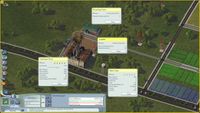
Furthermore buildings need access to roads and power to be able to function at all. Access to water, for some reason, as well as trash disposal are only required to help zones grow futher once they are established.

Same goes for civil services such as police (needed to fight crime), firefighters, education and healthcare. We will shortly take a look at to how these systems interact but first we will have to introduce the socioeconomic players of SimCity's simulation:

The game differentiaties between low-, medium- and high-wealth residents, commercial services (Cs) and offices (Co) as well as industrial interests who each have their own preferences in regards to land value and access to infrastructure. High-Tech Industry, for example, prefers unpolluted areas with access to a highly educated workforce and good coverage of police and fire services, making them the hardest type of industry to attract. Dirty and manfuctaring industry are less picky, but produce significantly more pollution in return. Futhermore development of a city is regulated by demand, which determines how much a of given zone will actually develop. The more build-up a city is, the more demand for high-wealth residents and businesses it can generate.
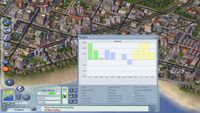
To determine diserability and demand the game models different feedback loops of which one example will be illustrated for clarity:
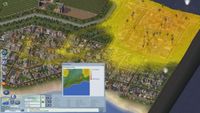
The above screenshot shows the air pollution produced by an area of dirty and manufacturing industry. Note how the farmland in the upper-left corner of the picture produces little to no air pollution but the parts of the road network with high traffic do.
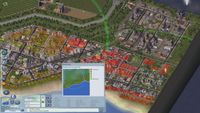
The above screenshot shows that the residental areas directly adjacent to the industrial park have lower "health" than those south of the farmland and are significantly more affected by the nearby air pollution.
It is interesting to note, that factors that typically denote quality of life are embedded in an economic context in SimCity. Health as a measurement index is revelant only in regards to how it affects the landvalue and desirability of potential businesses and industries. So while negative feedback loops such as pollution force government expenditure by building a couple of hospitals, whose "effective range" is visualized by the green circles in the above screenshot, these are still secondary to keeping the city's budget intact. As the second and third screenshots from the top have shown, infrastructure and civil services require funding to fulfill their functions. Government spending is then, unsurprisingly, financed by the bane of private citizens and multinational corporations alike, that being taxes of course.
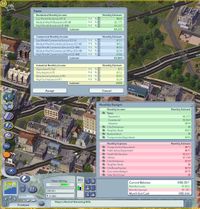
It should be noted that the game's tax rates universally affect desirability and demand of any actor in the game. Therefore maximizing growth requires low tax rates, for whatever business or industry the user wants to attract anyway, and lean government spending. This is also iterated in the tutorial of the game, which stresses that civil services, such as schools and hospitals, should only be provided once citizens start demanding them and not before(!) and then be as tightly budgeted as possible so government spending is minimized and taxes can be lowered further to attract more businesses and industries and therefore stimulate more growth, effectively mirroring neoliberal economic models, that over the years have produced many adverse social outcomes which are simply not realized in SimCity's simulation.
Like most casual simulations of this type, it fails to account for macroeconomic and larger sociocultural events extending beyond it's focus on the local environment. While SimCity 3000 follows calender years (and unlocks new buildings at the appropriate date - no nuclear power plants before 1960 for example), no city built in the game will ever be affected by the World Wars or have it's economy crash in the Great Depression or oil price increases during the peak of domestic US coventional oil production and subsequent oil crisis in 1973. Furthermore any economy has a limited scope (no GDP is, or is ever going to be, infinitely high after all) and therefore only has so many businesses to attract, however in SimCity this neoliberal growth cycle can be happily repeated ad nauseam without any negative feedback loops kicking in. In the same manner, local air and water pollution and their immediate feedback loops affecting the state of a town may be modelled but the large-scale consequences of this activity, like rising average temperatures and the consequent strain on city infrastructure will never catch up with it. To iterate: there will never be blackouts due to weather extremes caused by global warming, nor will the aquifers ever run out of water in SimCity. Economic externalities in SimCity, be they environmental or social in nature, truly are completely external and unrealized in the simulation.
Now we can make the argument that this was simply outside the scope of these titles but the observation that the model that operates simcities is also completely divorced from any historical, or cultural context outside the confines of it's own algorithms and their assumptions remains.
The overall model, then, is an exercise in speculation on how cities operate, and, as
players, we are given the opportunity to ‘‘read’’ these speculative arguments through
play. SimCity thus gives ‘‘imaginative form’’ to ideas concerning urban planning,
growth, and renewal. [...] And, as already
noted, the models are also shapers of metanarrative—that is, they dictate the ways in
which the cities built upon them will develop and change. All SimCity cities are tied
to these model-based metanarratives; the models themselves, then, are both the products
of and shapers of narrative fictions. (Wells 541)
The fiction SimCity creates through it's simulation then, would be that of an idealized neoliberal city where the role of local governemnt is comprehensively fulfilled in keeping the barriers of conducting business as low as possible and steering socioeceonomic factors, such as access to education, towards the optimization of business opportunities as well. A relevant sidenote may be that the game may not have a win-state, but it does have a singular condition for failure. Should the finances fall below 100.000 in the red the player will be kicked out via a humorous game over screen:
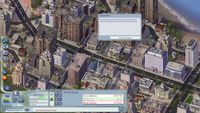
It is weird, but not surprising given what we deduced of the underlying assumptions of SimCity's simulation model, that the only failstate the game features is related to financial and not social factors, such as happiness or wellbeing of the simulated city dwellers. Indeed any measures the game tracks and models in regards to quality of life, such as life expectancy and access to education, are always secondary and subservient to the economic model of the simulation, which is the actual driver of the city in this model fiction. Visions of identity and community in SimCity then, may not be directly simulated in the model but they do creep to the surface in other ways.
For example further examining the use of language and register employed by the game allows us to make statements about communities of practice depicted in the game. While the game tries to sell itself as an unrestricted creative canvas, a literary reading of the game, especially it's graphic representation and how it meshes with the underlying model and it's biases still allows us to place SimCity 4 in a very specific moment in time and space. And last, but certainly not least, the game's reception has greatly extended beyond the immediate user engagement with the product and created a large fan community that uses SimCity in a myriad of unexpected ways. So taking a look at how fan productivity has shaped and transformed the ways SimCity can be approached and viewed is also noteworthy.